Showing posts with label ose. Show all posts

Friday, April 22, 2022

Running Wild

I spent much of last year running Old-School Essentials by the book: meaning, I only added a house rule into the game once the need arose (e.g. rules for magic staves or additional combat declarations). I gave the rules a chance before deciding to change something (Chesterton's fence and all that), or deciding that something was even meaningful or relevant to change at all.

That campaign focused mostly on traditional low-level play: a base of operations (Fourtower Bridge) with nearby dungeons (we visited Winter's Daughter, Hole in the Oak, Incandescent Grottoes, Prison of the Hated Pretender, Star Spire, and The Waking of Willowby Hall). It was great fun.

This year I wanted to focus on adventuring in the wilderness. I talked with my group, got an idea of what might interest them, and then set out to build a setting for their adventures. We began our campaign at the start of the year and it has been a resounding success.

Rocks fall, everyone dies: wilderness adventuring is a dangerous business!

Though I highly customized the setting, I took the same approach with the actual rules for wilderness adventuring that I did for dungeon crawling and combat last year: stick to playing it as close to "by the book" as I can before making changes.

You can find numerous blog posts and videos about hex crawling across the Internet, ranging from elegant and practical to needlessly complex. In fact, almost every hex crawl procedure that I found overcomplicated the process. You don't need to do this to run a wilderness adventure! A referee has everything they need to run an excellent wilderness adventure right there in the Old-School Essentials rules.

As you play, you will add to or clarify those rules. That is expected. But, if you start with the bare necessities, your brain will thank you later for the reduced mental overhead.

AN EXAMPLE OF PLAY

Here is a real example of a full day of wilderness adventuring from a recent session.

1. The party woke up at camp and I described what they saw in every direction. In this case large hills to their north, southwest, and southeast with an obvious stretch of open plain due east. I asked them what they wanted to do for the day.

2. The party decided that they wanted to try to find a nearby river, which they knew was somewhere to their west. Hills rose in that direction, but there were a few passes that they could try to pick their way through.

3. Now I rolled some checks: a check for wandering monsters (the result was high, a 5 or 6. No wandering monsters today). Then a check for losing direction (a 2, uh oh).

4. Since they started in a clear plain, they did not immediately lose their way. But, as they moved into the hills, I described them getting turned around as they tried to make their way across them to the west. They couldn't tell one slope from the next. I described the peril and presented their options: they felt confident that they could backtrack and get back to where they started the day, or they could try to push through in a random direction. They chose to backtrack.

5. Now, having lost half of the travel day in the hills, they were back where they started. I described their surroundings once again and this time they chose to head northeast, keeping to the open plain while skirting the range of hills to the north.

6. Since they were on horseback, they could still move pretty fast. By the book, a riding horse travels 48 miles per day in grasslands. Having wasted half of the day in the hills, I ruled that they could still make 24 miles of progress. I eyeball this on the map, drawing a line as I go. Hexes are six miles across, but sometimes they only clip a hex. So, I use the hexes more as measuring guides than actual units of measure.

7. Whenever they reach a point where their surroundings change, I describe that so they can reevaluate their options. In this case, a clear pass opened up to the northwest between two ranges of hills. They shifted direction, so I continued their line of progress to the northwest.

8. As the travel day winds down, I describe them coming across a smaller stream that flows into the river they're looking for. They decide to make camp there, where they each consume a ration.

9. I roll again for wandering monsters overnight: this time, I roll a 1. I roll again on my regional encounter table: a small pack of blink dogs. I roll a d12 to determine an approximate time of night when this encounter happens and get a 3 or 4, so the encounter takes place a few hours before midnight (3 hours after making camp).

10. I follow encounter procedures. The blink dogs end up playfully trying the lead the lawful party member to a nearby river crossing. He does not follow them the entire way, but the party decides to head in that direction the next day ...

WHAT DOES THIS LOOK LIKE AT THE TABLE?

We play on a virtual tabletop, but it would look very similar if we played in person.

The referee has their own map. This map is likely keyed and labeled. They do not share it with the players.

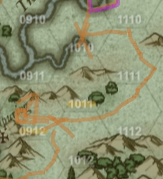
Here is a portion of my referee map relevant to the example above. They started the day at the X in Hex 0912. They traveled west into the hills and got lost. They backtracked and instead headed northeast, then turned northwest and camped by the stream at the X in Hex 1010.

The referee's wilderness map

As players complete their expeditions into the wilderness, I reveal those areas on their map. Note that I do not reveal as they go, only once they return to town. If the players want, they can make their own map based on my descriptions during an expedition. I highly recommended that my players do this.

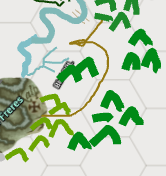
Here is their map. You can see a previously explored area in the lower left. A previous expedition had already traveled up the river to this point and returned to town. Notice that their scale is off, but it doesn't matter. I don't try to correct them. In fact, I don't even look at their map at all during play. If they have a question about their surroundings, they describe what they do in the fiction and ask me!

The players' wilderness map

That's it. Rinse and repeat. Make rulings as they come up. Add rules for things that become relevant to your table. Have fun!

Friday, March 4, 2022

Gotta Go Fast

Yesterday, I found myself involved in a fascinating conversation on Discord about running. Not running games, no ... running during an encounter in the Basic D&D tradition.

Adventurers showing survival instincts / cowardice

I will start here where I started yesterday: with the rules presented in Old-School Essentials. They are pretty clear. You can only run away, and only during a pursuit. 

I will call attention to the phrase "characters run at their full movement rate." I glossed over this when I initially read it. Since you find this section in the Encounters - Evasion and Pursuit portion of the rules, I assumed it meant the character's full encounter speed (usually 20'/30'/40' per round). However, compare that to the OSE section on retreating from melee:

See how the rules specifically state full encounter movement rate in this portion. So, first a character must declare a retreat. Then, the character may move 20'/30'/40' away. Finally, if they're still out of melee in the next round, they may begin to run (using their full or exploration movement speed; 3x encounter speed) and the enemy may pursue (starting the Evasion and Pursuit procedure). Well, wait ... can they? According to OSE: no.


So, OSE implies that you can only run (or, flee at 3x encounter movement speed) during Evasion and Pursuit, and that you can only trigger Evasion and Pursuit before combat has begun. That's kind of a strange limitation, but okay.

Then yesterday, on Discord, user @dcullina called to my attention that this isn't exactly how Moldvay Basic reads. Moldvay basically defines running in the same way, though it is more clear that when a character runs, they move at 3x encounter movement speed (a.k.a. your exploration movement speed, or full movement speed, as OSE calls it).

However, the paragraph on retreating differs in an important way:

Importantly, this paragraph does not specify that you can only move at your full encounter movement rate, as OSE does. It states "any movement at more than 1/2 of your normal movement rate." To @dcullina (and to me), that means that you could retreat and move your normal movement rate or run at 3x your normal movement rate.

Okay, maybe we're splitting hairs; reading into it too far. Maybe. But, check out what Moldvay writes on Evasion:

The caveat about "if [...] combat has not yet begun" in this excerpt seems to be a stipulation for evasion being automatic, not for the ability to evade altogether (as in OSE). You can try to avoid an encounter whenever you want, but if you've already engaged the enemy, it can't be an automatic success.

So, let's recap. In Old-School Essentials:

  • If you wish the retreat from melee, you must move away at your encounter movement rate.
  • Even if you get out of melee, you still cannot move at 3x your encounter movement rate for the rest of this encounter.
And, in Moldvay Basic:
  • If you wish to retreat from melee, you can decide to run, moving at 3x your encounter movement rate (and suffering the normal penalties for retreating).
  • If you are outside of melee, you can decide to run at any time, moving at 3x your encounter movement speed and not being able to do anything else (map, attack, etc.).
There is more to debate here. And, to be fair to the author of OSE, Gavin Norman, he does mentioned this in his Author's Notes:


Gavin clarified on Discord that the later edition to which he referred is likely Mentzer Basic, specifically this passage:


To me, the most interesting question is why can't characters run away at full speed once combat has been joined in OSE? I don't see that restriction as clear-cut in either Moldvay or Mentzer. And, for me, I find that the game works better when you give players an option to retreat (unless they make decisions that get themselves into a really bad spot).

All of this kind of points to the absurdity of getting hung up on "rules as written." Everyone views rules through a different lens. Which interpretation is right? Whichever one works for your table.

Saturday, January 1, 2022

When the Prince of All Toads Asks for Help

A few weeks ago, my party returned to the Incandescent Grottoes, where in Room 32 they discovered the self-pronounced "Prince of All Toads in the Magical Forest" who promises riches in exchange for aid. They decided that this sounded more promising than continuing their run of bad luck in the Grottoes, so they agreed to help the the amphibian.

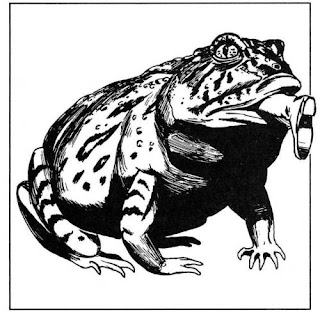
A less trustworthy amphibian

I determined that this toad was, as far as it was concerned, telling the truth, and I had it lead the party to a mini-dungeon where they could claim their treasure. I had been sitting on Dyson Logos' Goblin Gully for a while, dropping hints of a goblin hideout nearby, so I decided to use it for this little side quest.

Since we started this campaign with the Dolmenwood-based Winter's Daughter, I have styled all of my goblins like the whimsical goblin Griddlegrim in the Fairy tower at the end of that adventure. Using this variety of goblin changes the tone of the Gully quite a bit, as the goblins become less aggressive and more like annoying little tricksters.

So, I started modifying the Goblin Gully adventure to fit whimsical goblins, to add toads and magic mushrooms on the gully floor, and to tweak a few other things here and there. The end result was pretty fun.

This is just a riff on Dyson Logos' original adventure, but if your party ever decides to help the Prince of All Toads from the Incandescent Grottoes, or you just enjoy a more whimsical brand of goblin, take a peek at my modified Gully adventure below!


Wednesday, September 22, 2021

I Do Declare!

A few weeks ago, someone asked on the OSE Discord how other referees handled changing weapons during combat. Do you make players use a turn to change weapons? Do you let them do it freely as many times as they want? Can they only swap weapons quickly if they drop the first, but it takes a full action the sheath it?

I don't use any of those approaches. Instead, I made swapping weapons a part of the "Declare Spells and Retreats" step. If you want to change your weapon for the next round, you have to declare it before rolling initiative for that round. That's it. It doesn't "use up" your turn. If you declare it, it happens. But you don't get to change your mind if the turn plays out differently than you expected.

A PC declaring that he has swapped out what he was holding for his axe

As my first foray into running OSE has progressed, I've added more things to the declaration step. I find it to be ideal for decisions that telegraph what you're doing next. These are the decisions that might inform your opponent's actions, should they win initiative. In addition to the normal Cast a Spell and Retreat from Melee, I have currently added:

Charging into Melee - Declare that you plan to charge toward an opponent. You must start the round at least 20' away. You gain a +2 bonus to attack, but incur a -1 AC penalty. 

This is the first decision point that I added to the declaration step. I placed it here to solve the problem of "when does an opponent get to brace against a charge?" The answer: if you declare that you're charging (meaning, you start running toward them), but they win initiative and brace their weapon.

Swapping Weapons - Declare before initiative that you're swapping held items. If you do this while in melee, opponents get a +2 bonus to all attacks against you this round.

It didn't make sense to allow changing your weapons when in melee combat without some sort of penalty. But, that rarely comes up. This is usually used to swap from a bow to a sword when the enemy nears, or to place a lantern on the ground and draw a weapon at the start of a fight.

Aiming - If you have a ranged weapon out at the start of the round, you can declare that you're foregoing your movement to take careful aim.
  • If you're firing into melee, reduce your chance to hit a friendly character from 3-in-6 (50%) to 1-in-6 (~17%)
  • If you're firing at a distant target, you can fire as if the target is one step closer (ex. a medium range target becomes short range)
This rule doesn't have to be in the declaration step ... it's not exactly telegraphing your actions in the same way the others do. But, since it depends on not having declared a weapon swap, I put it there for the sake of simplicity.

Monday, August 30, 2021

Artificer Intelligence

I built an entire class for Old-School Essentials around the concept of the infusion mechanism detailed in my previous post. Since I cribbed the name "infusion" from the 5e Artificer anyway, I call it the Artificer here, though I also considered Enchanter or Mage-Wright.

The Artificer class for Old-School Essentials

I started with the Magic-User "chassis." It uses the same hit dice, level progression, saving throws, and base attack bonus.

The biggest drawbacks compared to the M-U: the Artificer's reliance on finding spell scrolls and then successfully crafting once they do. They have to jump through far more hoops to even have their first spell effect.

Because of those drawbacks, I give them a bit more up front:

  • The ability to wear leather armor and use shields. Since they don't have to perform an incantation like the Magic-User, they don't have the same limitations.
  • Access to a few extra weapons: the crossbow and the warhammer. For a class concept built around using tools to craft, proficiency with a big hammer felt right. Crossbows, being more like contraptions than other ranged weapons, are also at home here. If your campaign uses the new Black Powder Firearms rules from Carcass Crawler # 1, consider giving the Artificer access to the semi-martial firearms as well.
  • Since they depend on understanding spell scrolls to even gain access to magical effects, I give them the ability to spend a turn to decipher magical scripts. Essentially, they can Read Magic without casting the spell. Otherwise, they'd rely on a casting class to even get started tinkering.
Additionally, the mechanism itself has the same benefits that I outlined in my previous post: the potential to get more uses out of a spell scroll and opening up access to spell effects to other classes through your infusions.

For those of you familiar with Numenera, this class essentially creates cyphers: limited use arcane contraptions. You could even consider stealing that game's rule that restricts the number of contraptions any character can carry: carry too many, and they start malfunctioning and blowing up in your face.

A few more insights into my design choices:
  • The Level 11 class feature states that your apprentices arrive with spell scrolls of their own. This could insinuate that Artificers start with a spell scroll. If you choose to do this, I suggest randomly determining the scroll as if it had been acquired by chance.
  • Artificers can use spell scrolls normally, like other arcane casters, but they always have the Thief's 10% chance of error. They aren't quite the experts at casting that Magic-Users are.
  • The section on infusions does not explicitly prohibit infusing the same item multiple times. For instance, an Artificer 3 could infuse the same armor with Shield three times, thus giving it three charges. I find this to be an entirely viable interpretation!
  • Note that when the Artificer attempts to recharge an infusion, the original spell scroll is not required.
There you are: an Artificer for OSE. Steal it, mine it for ideas, use it for inspiration ...  it's yours to do with as you please!

Friday, August 6, 2021

Bringing a Base Town to Life

A few months ago, I shared my Between Adventures procedures from my ongoing Old-School Essentials campaign. It has worked well for my table. Like all good turn procedures, the time between adventures has a "ticking clock" that I called Scheming Factions.

These schemes take the place of random encounters or wandering monsters. Unlike wandering monsters, a scheme doesn't usually lead to an immediate encounter. Instead, schemes model the plots and machinations of various NPCs in the region, as well as random happenstance. Here are the current schemes from my town notes:


For every stay in town of a week or less, I roll a d6 for each ongoing scheme. Some schemes have multiple stages (like The Blood King in my example). If I roll a 1, the scheme advances sometime during the course of that stay. Schemes that have been on the list for a while might have a higher chance to advance (most of them do in my example above).

You don't need more than one ongoing scheme. In my example, I added every entry except for The Blood King to the list as a reaction to actions previously taken by the players. I like to use this to show the players that the world around them will react to their escapades, without arbitrarily dropping "plot" in front of them.

The best example of schemes in action in my current campaign comes from another multistage scheme no longer on the list, inspired by the adventure The Waking of Willowby Hall.

First, the rival party from that adventure made their way through town, boasting about the goose who lays golden eggs. Then, when it advanced again, they had stolen the goose and run back into town chased by Bonebreaker Tom.

The second bit happened as my party approached town. They heard the battle in the distance and then hurried into town to see that Tom had smashed up the inn and stolen the tower bell. He then chased the goose thieves to a manor house (Willowby Hall) outside of town.

Two town NPCs offered a combined 4,000 gp for the return of the bell, which enticed my party to go check things out. Unfortunately, they tried to talk to Tom instead of sneaking past him. The conversation did not go well and Tom smashed a PC with a boulder. My party ultimately retreated and decided not to engage with the adventure.

The rest played out "off-screen" while my party did other things. The next week, Helmut Halfsword of the rival party returned with the bell and collected the 4,000 gp for himself. I thought my players would be ticked off that someone else got their gold, but they didn't really seem to mind.

So far, this small table of schemes has been a low maintenance way to make my base town feel alive without overwhelming my players with quests and quest-givers. Show the world in motion around them and leave it up to them whether or not they decide to engage with it.

Sunday, July 4, 2021

Attending the Old School, Part 6

Here ends the story that began with two brothers inheriting the burial mound of Sir Chyde (Winter's Daughter) and continued with multiple expeditions to some nearby caves (Incandescent Grottoes) that would ultimately claim their short lives as well as the lives of their three companions.

That's right ... a TOTAL PARTY KILL. Here's what happened ...

A bystander captures the moments before a party meets its end

NOTE - Yes, there is a bit of a gap between my last Attending the Old School post and this one. The sessions ended up taking place primarily in town, dealing with the fallout of some carousing, and I didn't really have much of substance for a post. This was their first session heading back to the dungeon.

Dramatis Personae

Flynn, Level 3 Thief

Ancin, Level 2 Magic-User

Chadwick, Level 3 Cleric (NPC Follower)

Jaq, Level 1 Elf

Russell, Level 3 Fighter

Notable Events

  • Returning to the crystal caves, the party headed through the troglodyte spy tunnel in the first room. There they encountered two imperial soldiers searching for Marjoram, the fugitive illusionist. The soldiers got testy and Russell intervened, and the party agreed to go back the way they came.
  • Changing plans, the party ate some bubble moss and descended to the bottom of the pond in the first room. The water dumped them out into an underground river flowing north. Once they got their bearings, they found a sandy shore and climbed out of the water.
  • First, they followed some tunnels north, where Ancin, Flynn, and Jaq all got themselves blinded by some sort of magic device. Still blind, Flynn and Ancin decided to feel around the walls of the room. They found an exit, as well as two incorporeal creatures that chilled them to the bone. They fled, but Ancin fell to the icy touch, dead.
  • Jaq and Flynn regained their eyesight. Looking for a way out, the party all headed in the other direction, following tunnels south. They stumbled upon a crazy dreamscape. Jaq tossed a rock at the illusions, which interrupted the dream and awoke a dragon.
  • The dream dragon put Flynn to sleep with its breath. The party ran back to the beach. Russell took a few slashes from the dragon's talons as he brought up the rear, hauling Flynn in his heavy armor. The dragon pursued them around the corner, caught them all together on the beach, and with another mighty breath put them all into a deep sleep.
Referee Insights

Things went south quickly for our intrepid band of adventurers. But, I don't think it had to end this way.

We make so much out of the deadliness of old school pen-and-paper RPGs. "Combat is a fail state" is a common refrain. Newcomers worry that their players - perhaps more attuned to contemporary "heroic" games - will get into fight after fight out of habit, and die in the process.

One of the first adventures that I ran with this group in the old school vein was the Lair of the Lamb (using Into the Odd). It can be fairly brutal, and I impressed that brutality upon my players: you're groping in the dark while someone beside you gets crushed to death by a monstrous lamb-beast. You don't have much more than a single dagger between all of you. Your best choice is to run.

Well, after eight sessions of Old-School Essentials, I can certainly say that I must have made an impression. This party never resorted to combat unless it was forced upon them. Take this anecdote: Russell the fighter obtained Sir Chyde's +2 sword at the beginning of the third session. He did not swing it once before he died at the end of session eight. He never even knew what he had.

The thing is, they had two chances in this final session to benefit from standing and fighting. First, with the imperial soldiers. Second, with the dragon itself.

The party - five members strong at the time - encountered two imperial guards right off the bat. They outnumbered them more than 2 to 1. The guards had an unfavorable reaction roll (a theme for the night) and ended up being quite pompous. However, the party was hesitant to kill two "official" soldiers, so they fell back and avoided a fight.

I believe they could have leveraged their superior numbers, even if they decided not to fight to kill. Wrestle them down and toss them in the water. Tie them up. Or even just call their bluff - would the soldiers really attack if the party pushed past them?

I have conditioned them to avoid fighting at all costs. I see now that maybe I should not have been so heavy-handed with my message!

The dragon fight actually started well for the party. They didn't know exactly what they were up against, but I gave them a few hints that it was something big. When they interrupted the dragon's dream and awoke it, they rolled initiative and won. But, they didn't really decide what to do. They all ran into the room, took up positions, and waited (the dragon had not yet come around the corner). I think they were waiting to see if it wanted to talk.

In the moment, it made some sense. But, of course, they stayed bunched up near the entrance. So when the dragon appears, they're all sitting ducks for it's sleep breath.

But, they get lucky with their saves! 3/4 of the party made it, with only Flynn succumbing. At this point, I admit things aren't looking great for them. However, this dragon has 20 hp. I think, for them, they see a dragon and their minds go to 80, 90, or 100 hp. They've never really been in an OSE fight against anything with more than one hit die. I don't think it occurred to them that a dragon would be under 50 hp, let alone something like 20.

If they split up and start attacking after the dragon's first attack, I think they could have forced a morale check. They only needed 10 damage, and Russell is sporting a +2 sword. But, again, here their lack of experience in OSE combat hurts them. The concept of a morale check is still a bit foreign - to them, it's either they kill it or it kills all of them, with no middle ground.

As it was, they ran. Russell in his plate armor taking up the rear. He scoops up Flynn and gets mauled from behind. But, he only ends up taking five damage in total. So, here they have another round where they could have attacked the dragon. That's three rounds where 3 out of 4 party members could have attacked. It's entirely plausible that three rounds of attacks would have slayed this dragon!

Instead, they run back to the beach by the underground river. Here is where I think they made their only true tactical error of the fight (as opposed to misjudgment). No one tried to split up, or push themselves up against the wall to hide from eyes in the other room, or jump into the rushing river. They stood on the beach and the dragon came around the corner and put them all to sleep.

I'm sad to lose this party. We will continue in the Grottoes, rolling up a new party and getting back to it, but I plan to end this series of blog posts here for now.

My journey into by-the-book Old-School Essentials was enlightening and enjoyable. It helps that Necrotic Gnome's OSE modules are top notch. There is still a lot to learn from this set of rules 40 years later. Most notably, the procedures (and the idea of procedural play) will forever change the way I run traditional fantasy pen-and-paper RPGs. I highly recommend giving it a try.

Thursday, June 24, 2021

Never Let Your Friend Copy Your Magic Homework

My magic-user player found his first scroll a few sessions ago. I knew that Old-School Essentials - by the book - does not have rules for copying spells. The magic-user receives one spell per level, and that's that. If they want more, they must spend money and time on research.

However, the new Advanced Fantasy rules contain optional rules for spell books, including a rule that allows a magic-user to attempt to copy a spell scroll with a chance of success dependent upon their INT score:

A very advanced table (from the OSE Advanced Fantasy Player's Tome)

I like this table. It has a good B/X "mechanically unrelated to other parts of the game but feels right anyway" quality to it. I didn't love the price of failure, though. If the M-U fails their roll to copy the spell, they can never learn it again.

It's ok, but it also doesn't present much of a choice. I guess for spells that you really want the choice is "do I risk it or wait to level up and use my class benefit to obtain it?" But, for most spells, the choice is do I risk trying to copy the spell and fail or ... never get the spell at all? Wait until I research it? I think there is an even better way.

Treat the price of failure as the scroll itself. If you fail your roll, it doesn't copy to your spell book and the spell scroll crumbles to dust. Now your choice becomes "do I risk losing the scroll to possibly copy the spell and get to use the scroll later, or do I refrain and guarantee that I have the scroll for my next adventure?"

This has the added benefit of explaining why magic-users don't lend out their spell books for others to copy very often, besides the hand-wavey "because magic-users are selfish and greedy." If you lend out your spell book and your pal fails their roll, the spell gets erased from your book. Not good!

Monday, June 14, 2021

Attending the Old School, Part 5

As my players explored their base town of Fourtower Bridge over the last few sessions, they began to interact with the sandbox that I had stocked. I still remember years ago when I watched Matt Colville's video on creating a sandbox. It blew my little mind. It's such a simple idea: take various dungeons and other adventure modules and seed them across a small region for your players to discover. But, for some reason, I never considered doing it on my own. I was brainwashed by the campaign or "adventure path" style of running a game. Probably all of those Dragonlance books I read as a teenager!

Luckily, I broke that habit quickly when I returned to pen-and-paper RPGs a few years ago, mostly thanks to Colville's video. Even when I played primarily 5e, I stocked a sandbox for my players to explore. I made a few different choices this time around ... but, before we get to those, a recap:

Dramatis Personae

Flynn, Level 3 Thief
Russell, Level 2 Fighter
AncinLevel 2 Magic-User
ChadwickLevel 3 Cleric
JaqLevel 1 Elf (another new player!)

Notable Events
  • The party spent three days in town resting and healing up. Chadwick learned how to create holy water, Flynn joined Silar's guild, and Moira introduced then to Jaq Turntleaf - an elf who could guide them to the crystal caves
  • After a quiet travel day, the party decided to try to get some rest before descending into the dungeon. However, an encounter with a full-size roc in the forest changed their minds.
  • Chadwick loudly introduced himself to a group of kobolds, who provided some dubious information in exchange for the party letting them leave with their gathered purple moss. Russell escorted them out.
  • Ancin and Chadwick investigated a slime-themed corridor and got surprised by a pair of gelatinous squirms lurking on the ceiling. Jaq and Flynn killed one with arrows from down the hall, and Ancin put the other to sleep.
  • Chadwick barged into a room labeled Master of Dissolution and stomped on a giant rat carcass, which drew the ire of the three monstrous larvae feasting on its guts. Ancin put them to sleep, but not after they paralyzed Chadwick.
Referee Insights

Astute readers may have noticed that my players have entered a new dungeon: the Incandescent Grottoes. The first few rooms have been great fun so far. But how did they get there?

First, and probably most importantly, they had motivation. Since we're playing Old-School Essentials almost exclusively by-the-book, finding treasure is by far the quickest way to level up. This already puts the players in the mindset of engaging with the setting more. They're not looking for the "story" so that they can earn milestone XP. They want to know where the loot is!

Luckily for them, I have seeded the region with several loot-filled dungeons nearby. Quelle coïncidence! Here is my local hex map:

A box of sand (Hex Kit and tile set from Cone of Negative Energy)

Nothing fancy. I'm not even sharing this map with them - it's just for my reference. I used the arrival of a new player - Jaq - as an opportunity to give them a guide who knew the location of the Oak and the Grottoes. That meant no need to hex crawl or search. Just a day's journey, point-crawl style, to introduce some time and resource management complications.

Ok, so there are dungeons nearby. How do the players find out about them? Actively, not passively - my NPCs don't have floating question marks over their heads. They can either talk to NPCs to hear rumors through conversation, or they can head to the inn and buy the bar a round to get the rumors flowing!

Inspired by this post on rumors at Delta's D&D Hotspot, I decided to lean into rumor-gathering as a game mechanism: spend a night buying rounds at the inn (spending 3d20 gp/night) and automatically learn a rumor. I like this because it gives a way for players to quickly find leads without going from NPC to NPC waiting for someone to give them a "quest."

Now, it doesn't prevent NPCs from asking for things. Those requests will just be more organic; no need to shoehorn quests into normal conversations to keep the game moving.

During their first stay in town, they learned one rumor from the bar (using the "buy the bar a round" mechanism) about night tomatoes that grow under the Old Oak. Chadwick also learned a rumor from Moira the Holy through conversation: she believed he could find the gold teeth of St. Orlo in the Grottoes. They chose to pursue the latter for now, and I can't wait until they discover that the gold teeth are in the mouth of a troglodyte.

Monday, June 7, 2021

Attending the Old School, Part 4

Base towns are a staple of old school play: Hommlet, the eponymous Keep on the Borderlands, or Helix from Barrowmaze. They provide necessary elements in the old school gameplay loop, serving as a place to sell treasure, level up and heal up, gather rumors, and obtain goods and services. 

However, despite having clear procedures for the other core game modes (combat, dungeon adventuring, and wilderness adventuring), the OSE (and therefore B/X) rules curiously omit procedures for spending time in a base town despite specifically calling out designing a base town in the Referee's Tome:

When do you use the base town that you designed? (screenshot from the OSE SRD)

Last week, my players finished up their first adventure and returned to town. While running their time in town went fairly well, I felt the absence of the game structures that I had enjoyed during my previous sessions. I wanted a procedure for returning to town. So, I made one!

But, before I get to that, a quick recap of my last session:

Dramatis Personae

Flynn Four-Fingers, Level 2 Thief

Russell, Level 2 Fighter

Ancin, Level 1 Magic-User

Chadwick, Level 2 Cleric

Notable Events

  • Back in the mortal world, the party returned to Chyde's tomb to pilfer a few more things now that his ghost was in the Fairy Realm. However, still suffering from the floating effects of the green slime, Russell decided to go ask the dancing skeletons if they knew how to end them.
  • Amaranda and Brigforwith had no idea how to end the effects, but they did implore Russell to help them find whoever had violated their son's tomb! Russell promptly excused himself to go "find the perpetrators," and the party quickly made their escape back out through the wormhole.
  • As the only party member not floating, Chadwick tied a rope around the others and pulled them back to town like balloons, clearly enjoying his time in control of their movement.
  • Upon returning to the town of Fourtower Bridge, the party divided up their treasure and paid the local sorceress (Mistress Hecuba) to dispel the floating effects. After resting, they introduced themselves to a few more townsfolk, including the thief Silar and Moira the Holy.
  • Moira told them of a rumored relic lost in the "crystal caves" to the west - the gold teeth of St. Orlo - that she would love to have as a part of the shrine she's building. They decided that it sounded like a good lead on more treasure and that they would set off in search of these caves next week!
Referee Insights

As mentioned above, we wrapped up Winter's Daughter during the first 30-45 minutes of the session. You can read more about my thoughts on that adventure overall in my collaborative blog post with Wandering Wombat. I used the dancing skellies as a bit of pressure to keep the party moving, though I allowed them to go back and get more loot from Chyde's tomb - they had earned it!

Since Winter's Daughter does not include a base town, I had to find my own. I ended up mashing together the town of Fourtower Bridge from the blog Paths Peculiar with bits of Lankshorn from the second issue of the Dolmenwood zine Wormskin as well as a few tweaks of my own. I seeded the town with rumors for the adventures The Hole in the Oak, The Incandescent Grottoes, and The Waking of Willowby Hall. The party seized on the rumor for the Grottoes, so that's where we'll be heading next.

As the party returned to town and began all of the typical things that one does in a fantasy town, I couldn't help but notice how the OSE rules lacked a procedure for this part of the game. I missed having that to fall back on, so I created my own:

Between Adventures (PDF)

I had a very specific goal here: to outline a procedure for time spent in town that looked like it belonged in Old-School Essentials or B/X

I didn't aim to create an exhaustive list of downtime activities or to define all of the possible actions a faction could take. That's not really the spirit of the system. OSE provides a simple foundation that gives the referee plenty of room to make it their own. That's the charm of it.

These procedures do assume a pretty specific type of game, one where adventure rarely happens in town. You gather rumors, travel into the wilderness, find an adventure site, explore it, and then return to town with loot. Rinse and repeat.

However, the concept of "scheming factions" does give the referee the option to add some ticking clocks like approaching armies or impending disasters. For instance, one of my schemes is that of the rival party from Willowby Hall, who will eventually bring Bonebreaker Tom smashing through town. I plan to elaborate on scheming factions more in a future post (edit: HERE).

I will use this procedure as my party moves on to their next adventure. It mirrors what they did naturally, so I expect it to be pretty seamless. But, it will help to give me some structure to fall back on as I run the game.

Sunday, June 6, 2021

A Dialogue Regarding Winter's Daughter

A comment on my second "Attending the Old School" post mentioned that another OSR-focused blog - Wandering Wombat - had written up a very similar post about the impact of reaction rolls during their second session of Winter's Daughter mere days after my own. I had read Wombat's blog and responded in jest that the two of us should collaborate on a Winter's Daughter retrospective.

Later, I reached out to Wombat on a whim and, lo and behold, we decided to actually write up a look back on our experience with Old-School Essentials and Winter's Daughter together!

It turns out that we came to the adventure from a very similar place: both using it as a first adventure for groups new to the OSE rules. Our dialogue below focuses on our experience as referees with the adventure - how we approached it, our challenges while running it, and the elements that really made it a joy to run as a referee.

The jerk who kept Princess Snowfall-at-Dusk from her beloved (art by Erol Otus)


How much experience did you and your players have with Old-School Essentials before this adventure?

eegag: Absolutely none. One player had played some Basic D&D as a kid, but even he came from more of an AD&D background.

wombat: Also none. I have two players who are recent converts - they have only played a 13 session run of "Blades in the Dark" before this game. My other two players are more experienced in general (AD&D, 5e, and other games) but not with OSE/Basic.

What house rules did you use, if any?

wombat: Hah! Isn't it the definition of Old-School to tinker? We've got a couple. The main one is encumbrance. We do (10 +Con mod) slots. Over that you are encumbered. Our magic users are also using Wonder&Wickedness magic (no spell levels, 1 cast per character level per day). Since we've introduced a couple of extra systems (herbalism from Cthonic Codex, Hunting from Into the Wyrd and Wild) but nothing else fundamental. I think that is one of the strengths of OSE (and basic D&D in general) - The absolute core of the game is a really simple fallback, but specific situations can be covered by an rule if necessary.

eegag: You are right about house rules essentially being part and parcel with the old school approach! For that very reason, I wanted to start by playing Old-School Essentials by the book, to make sure I gave the core rules a chance before ignoring anything (decades of wisdom be damned!). So, we did not use any house rules or even OSE Advanced Fantasy rules.

That said, after completing Winter's Daughter we have already decided to move to slot-based inventory. I also think any of the other bolt-on systems mentioned by Wombat above would work perfectly well in this adventure. As mentioned, the OSE chassis can take quite a lot of modifications and still run smoothly.

What level(s) were your Player Characters when they started the adventure?

eegag: I granted my players 2,000 xp upon character creation. This meant that my thief, cleric, and fighter all started at 2nd Level, and my magic-user was still at 1st Level. I don't believe this is necessary for the adventure - it isn't particularly deadly. I did want to impress upon my players the differences between classes when it comes to experience requirements, and help them understand the system a little more in general by leveling up before we even got started.

wombat: 1st level. This was the first D&D adventure for my current players. They had noticed immediately how fragile they were even though I gave max HP for the first level. The first encounter outside was with a talking beast (bear & deer) and they were very careful not to antagonise. The first real combat with the holy artifacts was a real wake up call - survivable but serious! I think this makes a really great introductory adventure. Yes there is some danger, but not if the characters are clever.

eegag: Yeah, it really does hit a sweet spot. If I run it again, I will not grant any bonus XP to start.

How many sessions did the adventure take?

eegag: 3 and a half. This included character creation, a scene setting up the inheritance plot hook, and the introduction of a new player after the first session. It's easily a 2-3 session adventure, even with a fairly methodical party.

wombat: 2-3. 2 for the actual adventure, and 1 for character creation. We used the "Beyond the Wall" character creation system of playbooks. It gave the character's a joint history and a home base town. It's a little time consuming, but everyone was excited and eager for the next session. I gave the players the option of 1 of the three hooks (Dreams, Inheritance, Plunderers) and they choose the Inheritance.

The actual "dungeon" took 2 sessions (voice+text, 3 hours) and the players were very focused. I could easily imagine 3 sessions if they had explored the side chambers or had more encounters.

Did you make any changes to the adventure as written?

eegag: A pair of minor changes:

  • I thought that the stone coffers in the family crypt deserved a bit of treasure, especially since the dancing skeletons will attack if the party disturbs them. I turned Brandywith's ash staff into a minor wizard's staff and placed two gemstones on the eyes of Emaline's mummified cat. My party only found the staff.
  • By the time they reached the Fairy Realm, 3 of my 4 players were covered in green slime. I had the effect wear off while in the Fairy Realm, but it returned once they came back to the mortal world.

wombat: The initial encounter (Drune Sacrifice) I changed to be "over", so our magic-users were fascinated with the magical residue of a ritual that gave hints... I also made the "floating slime" time limited (d6 turns) and wear off when entering the Fairy Realm.

Otherwise as written.

eegag: Interesting that you changed the old encounter to be more like the new encounter without necessarily knowing of the new encounter beforehand!

Did any of your Player Characters die? How?

wombat: No, but it came damn close! In the first chamber with the "angry holy items" everyone was wary of the whispering voices, except for our Witch's Apprentice who accused right back and walked in.. and was mobbed by all 4. She only survived thanks to being literally covered by the Knight (who survived thanks to shield and heavy armor).

After that they got serious about marching order, and trying not to antagonise anything!

eegag: Even with the bonus XP to start, we had our fair share of close calls as well. My party's weakest member - the thief with a -2 CON modifier - was also the only non-Lawful player. This meant that the holy objects went straight for him when they attacked. He was incredibly lucky to survive that encounter. My party's slow fighter also got surrounded by guards in the Fairy Realm and had to pull out a few tricks to keep the pursuit at bay long enough to get back home.

How much treasure did your players carry back to town?

eegag: 6,300 gp - they got the jewelry from the dancing skeletons, Chyde's bracelets and candlesticks, about 20 items from Snowfall-at-Dusk's jewelry boxes, and a couple of other small items. Additionally, the Fighter took Chyde's enchanted sword.

wombat: Wow, I was a little generous perhaps? The players were very careful not to plunder the tomb (belongs to their family! Although the Freezing Mirror was taken. The main reward came from the jewelry box - they were given the box as a reward for reuniting the pair (Princess was "encouraged" by the other elves) as well as fur coats and a necklace each. The most prized reward was a bottle of Fairy wine (which for us was a multiple dose "healing" potion).

eegag: My players got really spooked by the freezing mirror. Once they unfroze those who had been paralyzed, they kept their distance. I had hoped that they would haul it out or, better yet, use it as a weapon!

What room or encounter did you find the most difficult to adjudicate?

wombat: Most of it was a breeze to be honest. There were clues lying around, there was a very strong "fairytale logic" that the players latched onto and used to their advantage. Chyde had to "give directions" though as the players got the impression that the "fairyland" was somewhere else in Dolmenwood.

eegag: I had some trouble in the Fairy Prison. I didn't know how to handle their interactions with the bored guests other than very basic responses. It was hard for me to convey what was really going on there - that they had been waiting for ages. And then, when my thief stole Snowfall-at-Dusk's jewelry, how would they react? Of course the guards immediately responded, but I had the guests stand by confused as they watched the guards chase the party out of the tower. They were just kind of ... there in the background.

Looking back I suppose I could have made a reaction roll for them, but since they weren't the primary participants of the encounter I didn't consider it at the time.

What surprised you the most about how your players handled a particular challenge?

eegag: I did not expect them to engage as much as they did with the dancing skeletons. Because I used the inheritance plot hook, the fighter and thief appealed to the skeletons as their ancestors, and with the help of positive reaction rolls won them over. As a result, that encounter really moved the whole adventure along - literally, as some of the PCs went on a floating dancing tour of the burial mound's main rooms. All of this came from an encounter that I had expected might just end in a Turn Undead attempt!

wombat: Ha! You and me both. The Skeleton couple were the MVPs of the adventure. My players got the names of the dogs out of them as well - they supposed that the parents of Chyde would know what he called his dogs. So after a funny social scene/impromptu ball, the players had the names and had promised to take the Skeleton couple to visit their descendants.

eegag: Yep, although my skellies didn't outright give them the name, they took them to see the mural of their son and the players took it from there.

Do you consider the adventure easy to run? What made it easy (or difficult)?

wombat: This was a breeze to run. Maps on the front/back inside covers, the layout of the rooms (lists, bolded words, etc) made it easy to describe what was visible and adjudicate what the results of interaction were. Also the "fairytale logic" inherent in the plot made it easy for the players to pick up what was going on.

eegag: Incredibly easy, one of the easiest I've ever run, and definitely the easiest that wasn't a one-page dungeon. The pacing, especially with the new Whything Stones scene, made it feel like the adventure moved itself forward. For such a short adventure, it's packed with a great mix of curiosities, puzzles, encounters, and loot, all while maintaining a consistent internal logic (or, like you say, the inherent "fairytale logic.").

Would you make any changes to the adventure if you ran it again? If so, what?

eegag: I would keep the minor changes that I made this time, and I would probably add some reference to cold iron within the burial mound itself (perhaps a cold iron dagger held by the footmen statues has "elfbane" engraved on the hilt).

One bigger change that I considered has to do with the original "Whything Stones" encounter. I quite like the new version. It hints toward spooky goings on without interrupting the pacing of the adventure and it's a better choice in this context. However, the Drune arriving and beginning a sacrifice (from the old version) could serve as a very interesting random encounter if the party has explored the tomb for more than a few hours. I'd only add that, however, if you were exploring the larger Dolmenwood setting as an ongoing campaign.

wombat: Hmm. I would make more of the Elfin celebration - all those nobles and knights sitting eating and making small talk. I think I'd give more names (I had "The master of ceremonies" as the main point of interaction) and have them make requests of the PCs. I mean - bored, jaded Elves looking for distraction!

I almost would want to change the location of the portal to fairy... perhaps add another staircase in the chamber with Chyde? Not 100% sure though.

But other than that, I LOVE this adventure and want to try a few more by Gavin Norman to see how they compare.

eegag: Ah, I like your Master of Ceremonies idea. That could have helped me handle the bored guests and really show that boredom to the players (as the MC requests some entertainment because he has run out of ideas or whatever).

I think Winter's Daughter can be easily tweaked for any table, but it doesn't require any changes at all to be a ton of fun. At the moment, Mr. Norman has the Midas Touch. My party is headed to the Incandescent Grottoes next, and I can't wait!

Sunday, May 30, 2021

Attending the Old School, Part 3

Do you ever wonder what "rulings over rules" looks like in practice, especially for an OSE (B/X) newbie like me? Do you want to see one of the more meaningless instances of adding a PC's attribute bonus to a roll? Well, aren't you in for a treat with this blog post! 

Below I take a look at three oddball scenarios from my last session and discuss how I ruled each one. But first, a brief recap of my third session of Winter's Daughter. 

Dramatis Personae

Flynn Four-Fingers, Level 2 Thief

Russell, Level 2 Fighter

Ancin, Level 1 Magic-User

Chadwick, Level 2 Cleric

Notable Events

  • While the dancing skeletons Lady Amaranda and Lord Brigforwith took Flynn and then Russell on a tour of the tomb, the others investigated the family crypt but only made off with an ash staff inscribed with a glyph.
  • The skellies showed Russell the mural of their pride and joy Sir Chyde in a yet unexplored room. After bidding the dancers adieu, they returned to that room and found Sir Chyde's fabled sword as well as the name of his second hunting dog.
  • Using the hound names as the key, the party entered Chyde's tomb. Russell pandered to his hero and promised to reunite him with his beloved, while Flynn tried once again to steal precious jewelry from right under the nose of the undead.
  • Following Chyde's directions, the party descended into the realm of Fairy. The goblin doorkeeper allowed them entry as long as they could entertain the guests by consuming some of his mystical shrooms. Flynn's eyes moved to his hands and Ancin's skin turned purple.
  • An elf guard escorted the group to the princess, where they delivered Sir Chyde's ring as promised. The princess offered them anything in return, and Flynn quickly wished for his eyes to return to his face. He then proceeded to steal the princess' jewelry, get caught in the act, and barely escape back into the mortal world.

Referee Insights

A lot of old school primers stress rulings over rules as a tenant of old school game-play. During this week's session, my players put me into several tight spots where I had to make on-the-spot rulings. Some were lame, some I'd use again. Let's take a look at the good and the bad to see what "rulings over rules" looks like in practice for a referee new to Old-School Essentials.

SCENARIO 1: Flynn tries to sneak the copper bracelets off of the skeleton of Sir Chyde

Russell had already done a great job engaging with Sir Chyde at this point (and got a 13 total on his reaction roll), so he had sufficiently distracted his ghost. Chyde consented to allow Flynn to retrieve the magic ring from his skeleton, and Flynn wanted to try to pilfer Chyde's copper bracelets while he was at it.

First, I gave him a pick pockets roll, which he failed. So, as Russell entertained Chyde with the random facts he has come to be known for, I allowed Flynn another attempt. I used a variation of the test I devised last week for stealing from the dancing skeletons. Flynn could roll 2d6+1 (his DEX bonus): 10-12 = he gets them both, 7-9 = he gets one, 2-6 = something goes awry.

He rolled a 6, then added his DEX for a total of 7, barely getting away with one. I narrated the bony arm slipping from Flynn's grasp only for him to catch it just before it clanked against the coffer. I was satisfied with this ruling. The tried and true Turn Undead / Powered by the Apocalypse 2d6 resolution mechanic felt right here because it gave his attribute bonus slightly less impact than last week's 1d6 version.

SCENARIO 2: An elf guard interrupts Flynn ransacking Snowfall-at-Dusk's jewelry

The party had just reunited Sir Chyde with his lost love, and as a reward Flynn wished for his eyes to return to his face (understandable, though Chadwick wasn't happy). Flynn still had his eyes on the princess' jewelry boxes, though. As the happy couple descended to join the party, he made his move.

At the same time, I made a random encounter check and rolled a 1: an elf guard was coming to retrieve them. How many objects could Flynn steal before the guard arrived? There were, I believe, 43 objects in total. Eyeballing it, I had Flynn's player roll 2d20+1 (again his DEX bonus): he could dump that many items into his pack before the guard made it to the top of the stairs.

A thief slightly confused by his referee's task adjudication

I was a little less happy with this ruling. Looking back, I feel like I could have done something to give the player more of a push-your-luck choice. Perhaps returned to the trusted 2d6 roll: grab a number of items, then roll 2d6 with a bonus or malus equal to how far below or above that number was from your DEX score.

SCENARIO 3: Russell tries to hold the door while Chadwick stakes it shut

I have temporarily forbidden myself from using roll-under ability checks. As a player coming from attribute-centric systems (5e, Into the Odd, and Knave), I believe that rolling against ability scores is a crutch that would pull me away from the old school spirit. We should be able to play just fine without it!

That said, I have found myself leaning heavily on the PC's "open stuck door" chance for physical tests, and that's exactly how I adjudicated this situation.

Flynn had stolen from the princess, and the party had been made. Snowfall-at-Dusk called the guards, and they grabbed Russell (the slowest PC in his plate mail). After a scuffle, he retreated down the tower and got to the exit with guards hot on his heels. He wanted to hold the door while Chadwick staked it shut, so I allowed him a 4-in-6 chance (his open stuck doors chance) of success. He succeeded and gave them enough time to escape from the Fairy realm.

Saturday, May 22, 2021

Attending the Old School, Part 2

I find the referee procedures of older editions of D&D very appealing. They are succinct and simple and therefore very adaptable, yet despite their brevity they manage to cover most common situations. Each set of procedures (for wilderness and dungeon adventuring turns, for encounters, and for combat) contains a collection of tools (surprise checks, reaction rolls, morale checks, etc.) that have broad applications once the referee gets used to them. This loose yet clear structure is one of the features of Old-School Essentials that drew me to the system in the first place.

As with its class options, I find that OSE once again sits in the sweet spot. In modern D&D, these procedures have faded into the background over time, and any mention of them in the rule books sounds rather hand-wavey. Sure, worry about tracking time, but just ... do what feels right. I'm sure this complaint sounds all to familiar to anyone in the OSR scene.

However, on the other end of the spectrum, you have the extremely rules-light systems like Into the Odd or Knave that reference morale and reactions but make an assumption that the referee already knows the various procedures that suggest when to use them. For a lot of their audience, this may be true. But for me, I didn't fully grok a "dungeon turn" until I read through Old-School Essentials.

Understanding these procedures as a basic framework for how to manage the game drastically improved my ability as a referee and also provided a great foundation to build from when customizing the game for my players.

My second session of Winter's Daughter featured a good example of how I used a classic referee tool: the reaction roll. But, before I get into that example, here is a quick summary of the session:

Dramatis Personae

Flynn Four-Fingers, Level 2 Thief

Russell, Level 2 Fighter

Ancin, Level 1 Magic-User

Chadwick, Level 2 Cleric (a new player)

Notable Events

  • The party met a cleric named Chadwick sitting in the chapel to St. Sledge in prayer and allowed him to join in their exploration of the burial mound
  • Near the main entrance, four religious objects floated up and attacked Flynn specifically (our only non-Lawful PC). The shifty thief managed to dodge the attacks while the party bashed the objects to bits
  • The party crossed through a room with a full-length mirror and evidence of a stolen statue, but when they moved to investigate, foul sorcery tried to paralyze them. Russell and Chadwick both had to be splashed with holy water to remove the effects. Being fresh out of more holy water, the party backtracked to take another route
  • They entered into the family crypt where they discovered two animated skeletons (Sir Chyde's parents) dancing in mid-air. After Russell made a good first impression, Flynn turned on the charm and joined them for a floating dance while managing to steal their jewelry in the process
Spooky scary skeletons (Three Dancing Skeletons, James Akin)

Referee Insights

When I read through this adventure, I identified the encounter with the dancing skeletons as a great opportunity to lean into the reaction roll; they aren't portrayed as your normal mindless undead.

Russell burst through the heavy door first and into the crypt, disturbing the skeleton dance. I immediately rolled 2d6 for their initial reaction, and got a 5: unfriendly. I portrayed them chiding the party for being disrespectful and interrupting their dance. 

Russell immediately became apologetic and brought up his apparent distant relation to the family. After some groveling, I performed another reaction roll, adding Russell's +1 Charisma modifier and got an 8: indifferent. They went back to their dancing and stopped harassing the party, and even said that they'd allow their relatives (Russell and Flynn) to join in.

At this point, Flynn entered the room and spotted the jewelry that the skeletons wore. He accepted their invitation and joined their floating dance. He tried to pickpocket using his thief skill, but failed: no easy pickings this time. 

I had forgotten that the party thief was a charmer with +2 Charisma, and he decided to try to use that as leverage to distract them. I made one more reaction roll and got a 12: they were smitten and started passing him back and forth. With that, I gave him an x-in-6 chance to try to nab the jewels without his preternatural abilities. He rolled well and got them both, the skellies being none the wiser.

Two things set this example apart from a modern "persuasion"-style check:
  1. Varied degrees of success and failure: the roll doesn't default to a binary pass/fail outcome
  2. Probability curve: unlike a d20 check, the reaction roll tends toward the neutral result
Both of these elements yield rolls that tend to be easier to interpret or reconcile with the fiction.

Additionally, the example above demonstrates the flexibility of old school referee tools. I used a reaction roll to establish the skeletons' initial disposition and then also to measure the impact of active player effort. It's multi-purpose and leaves room for interpretation by the referee; hallmarks of the old school mindset.

For anyone interested in porting a reaction roll into more of a check-style approach, I talk about it in a previous blog post.

Friday, May 14, 2021

Attending the Old School, Part 1

Over the last few months, I have been a player in pen-and-paper RPGs far more than I have been the referee. However, I recently received all of the adventure PDFs from the Old-School Essentials Advanced Fantasy kickstarter. Reading through them immediately had me itching to get back into the saddle, and this week I started my first ever Old School Essentials game with Necrotic Gnome's excellent adventure Winter's Daughter.

This will also be the first time any of my players have used the Old School Essentials rules (though one of them did play Basic long ago as a kid).  I have decided to write a series of blog posts peeking behind the curtain of a first-time OSE referee running the game for first-time OSE players. The posts will include basic recaps, but will primarily focus on what I learn about running OSE every week. I will look to Thursdays in Thracia for my inspiration, as I love how it dives into the referee's thoughts while running old school adventures.

Baby's first retroclone

Dramatis Personae

Flynn Four-Fingers, Level 2 Thief

Russell, Level 2 Fighter

Ancin, Level 1 Magic-User

Notable Events

  • A church bureaucrat named Symart Bourne delivered an inheritance to Flynn and Russell during a game of bocce ball. Uncle Terrance had died and bequeathed upon Flynn (the elder brother) a deed to the burial mound and belongings of Brigford the Wise, brother of the legendary war hero Sir Chyde
  • Flynn and Russell recruited their extremely tall mutual acquaintance and Russell's self-styled academic mentor Ancin to join them in investigating the burial mound
  • Outside of the mound they found evidence of Drune rituals, so they quickly made their way into the tomb through a small natural tunnel that turned out to be the egress for a nest of 4' long tongue-like worms; Russell slew two wormtongues with the help of a Sleep spell and a third slithered away
  • The tunnel led into a sort of office or living quarters that had long been used as the lair for the wormtongues, and within they found a book containing a fancy poem about Sir Chyde's hunting dogs
Referee Insights

Character creation took up the first half of the session. We ended up with a very traditional fighter, thief, magic-user lineup, and I awarded them each 2,000 XP as a "welcome to OSE" gift. I also gave an overview of the rules differences between OSE and other systems we've played. The group caught on quickly - I probably went into more detail than necessary.

Before the session, I had corresponded with another blogger (IdleDoodler at There Could Have Been Snakes) about moving from minimalist OSR systems to OSE, a system with well-defined classes and procedures. My players have struggled a bit with classless systems for any adventures that went on for more than a session or two, and I speculated in our correspondence that even the streamlined classes of OSE could provide them with archetypes to lean into.

In addition to a class archetype, we also rolled on either the Personality or Mannerism table from Maze Rats for each character. It amazes me how much a single descriptor can bring a character to life. Russell the Fighter, who likes to share random facts to impress his mentor Ancin, proved to be a highlight of the evening. 

Right off the bat, the role-playing had a little more meat on its bones. You don't need pages of backstory and limitless class options to find a personality for a new PC, but it helped my players to have a class and a trait to provide that initial foundation.

As for the adventure itself, I went with the inheritance hook with the added caveat that they only had one day to venture out to the property to claim it, just to ensure that they didn't dawdle. I hand-waved the starting town and the wilderness travel to get there. If we continue with additional adventures after this one (which is my hope), I will flesh things out more at that time.

My party chose not to bring any retainers with them, so they actually did not have enough cumulative Strength to move the stone blocking the entrance. I hinted that it could be broken, but they decided to look for other ways in instead. This led to an encounter with the ravenous wormtongues in a narrow tunnel. 

The wormtongues weren't capable of penetrating Russell's armor. Even with a surprise attack on him, they never landed a blow. I narrated one trying to slide across the "ceiling" of the tunnel to get by him, but Ancin hit it with a Sleep spell and Russell slew it. I rolled Morale for the final monster and it retreated, so the encounter turned out to be pretty easy.

In the priest's quarters, they missed the loose flagstone, which is one of the bigger caches of treasure in the adventure. I have decided to play the Thief skills more as preternatural abilities - anybody can locate a trap by examining an area, but only a Thief can detect it on instinct alone without specifying where they look. I started long ago to break my players of the habit of calling for Spot checks instead of narrating what they do, but I still think it's a bit weird for us to have a class with a bunch of skills that the player doesn't "use" and instead the referee rolls for them passively behind the scenes. I quickly saw why the Thief class has been bemoaned and debated so thoroughly over all these years.

My Find Traps roll for Flynn failed, and no one described inspecting that part of the room, so the treasure went undiscovered. It did make me wonder how players trying old school adventures for the first time should learn to think in a way that would lead them to discover that treasure. Should I have described loose stones throughout the room to pique their interest and then, when they asked to check them out, say they're scattered throughout the room so they need to specify where exactly they examine? 

I know that players will miss treasure sometimes. It happens. But something about this specific scenario didn't sit well with me. I need to put some thought into how to train my players to learn that sometimes they have to sniff out treasure - it isn't always in the most obvious places.