Showing posts with label experience. Show all posts

Saturday, March 9, 2024

Creating Tension through Character Advancement Rules

A few days ago, user Ryan on the Necrotic Gnome Discord server asked if anyone used a simpler version of 3d6 Down the Line's "Feats of Exploration" XP rules, something without its extra calculation steps. I shared my campaign's rules for gaining experience through exploration, and the subsequent conversation led me to ponder the role of character advancement rules in adventure and campaign design.

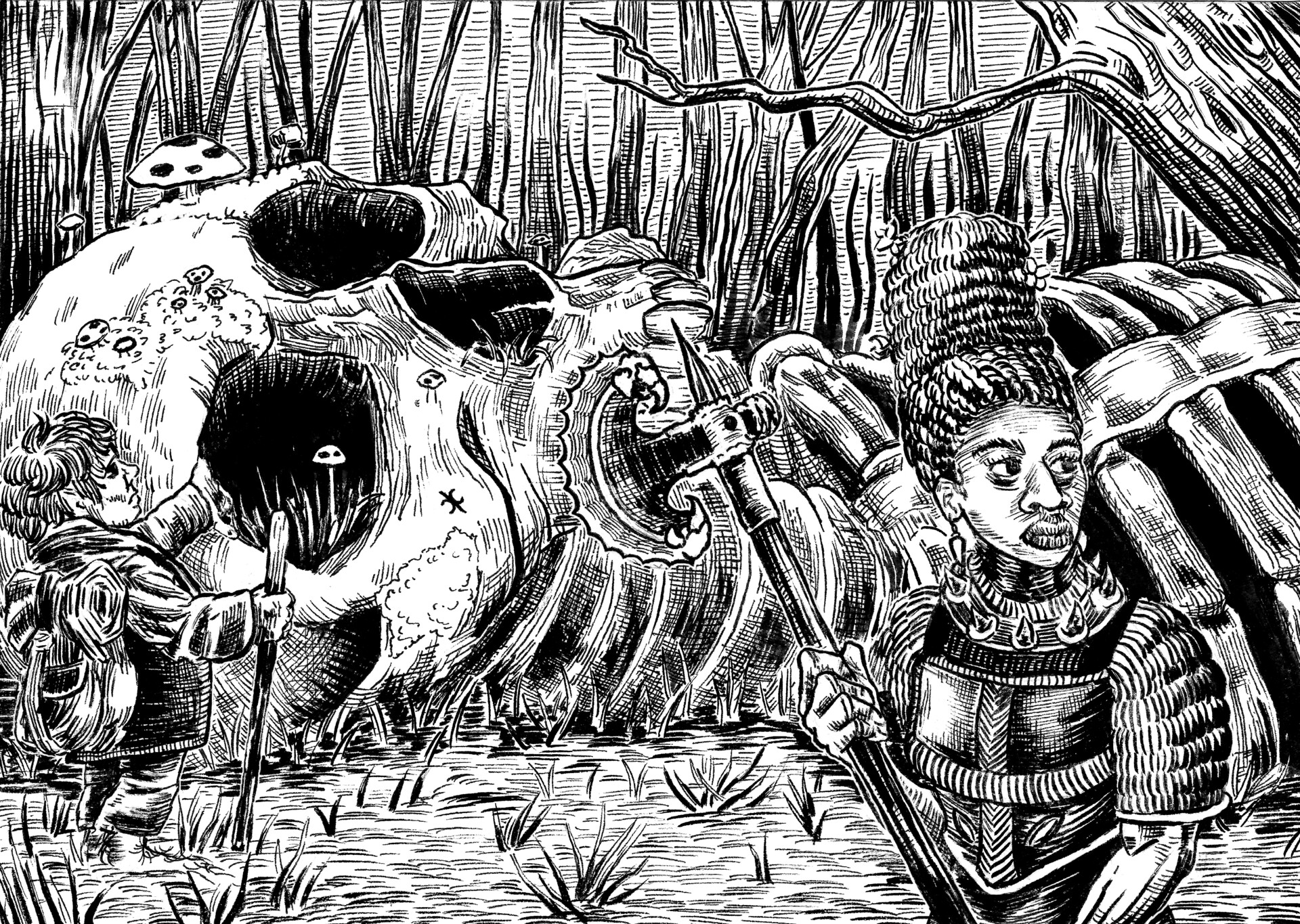
There's always treasure inside the giant skull (art by Carlos Castilho)

Your rules for character advancement should reflect what's important in your campaign, and should reinforce the campaign's tone and hammer home its general vibe. Experience points for treasure sets this precedent. It incentivizes players to do anything for gold, and thus they become the very scoundrels and antiheroes of Sword & Sorcery that early TTRPG innovators sought to emulate.

XP for GP turns PCs into Fafhrd and the Grey Mouser. XP for slaying monsters turns them into Geralt of Rivia. XP for stepping out their front door and going on an adventure turns them into Bilbo Baggins. You get the idea.

Let's be real, though: XP for GP is the best of these. But why? When PCs delve into the dungeon, they push deeper and deeper to accumulate more and more loot. Most importantly, the players strive to accumulate as much loot as they can in a single trip. Because, every time they leave and return, they must ...

  1. Ascend back to the entrance of the dungeon safely
  2. Travel from the dungeon back to town safely
  3. Resupply for another trip
  4. Travel back to the dungeon from town safely
  5. Deal with new threats that have moved into the dungeon
All just to get back to where you made it last time. Who wants to do that? These serve as cons against leaving the dungeon for both the player and the character. The character has to spend more money to resupply and risks more random encounters. The player has to spend more play time retracing their steps and dealing with logistics.

Don't get me wrong: spending play time on logistics can be fun. My current campaign revolves around exploring an uncharted continent; trust me, we love logistics. But, it's not something you want to keep doing over and over in a short period of time. You want each expedition into the dungeon to be worth it.

All of this comes together to give the adventure a sense of velocity; momentum pushing the players in one direction. Keep delving, get as much treasure as we can possibly carry. Hire retainers and buy mules just to carry more treasure per trip. Open another door and risk another encounter.

Along with this momentum comes increasing risk, which in turn gives the game an intoxicating sense of tension. As you delve deeper, characters use up more resources. They carry more treasure: heavy bags of coins and bulky golden statues that slow them down. And, they attract more attention with their light and noise.

Rules that primarily grant experience for slaying monsters don't typically provide the same combination of velocity and risk that creates this delicious tension. If your goal is to slay monsters, then running into monsters isn't exactly a con. This leaves resupplying as the only valid con from the list above, and when a system trivializes resource management with powerful spells or simply hand-waves it altogether ... well, then the tension evaporates completely.

So, when you grant character advancement via means other than treasure, your game benefits if you can recreate that same velocity-risk cocktail. In my campaign, with its emphasis on wilderness exploration and discovery, I did this by granting an exponentially increasing amount of XP for every fully explored area (or, a 6-mile hex). Exploring that first area grants only 200 XP. By the fourth area, the character can earn 1,000 XP just for pushing on into the fifth.

Earn XP for Exploring the Wilderness!

This drives the players toward longer expeditions that go further from home. It encourages them to spend just one more night in the wilderness only to stumble into a new faction's territory the next day. During my campaign, this has yielded multiple exciting races to get home, where players have gone without food and rest in a mad dash to get to safety before they starve to death or get caught by monsters.

By customizing the game's source of character advancement while maintaining the same tension inherent in using XP for GP, the players themselves have chosen to go on exactly the sort of adventures that I have yearned to portray. And, they've done it for diegetic reasons that maintain a sense of coherency within the fiction.

Thursday, November 18, 2021

When It's Time to Party, We Will Always Party Hard

My Old-School Essentials game that started six months ago has continued weekly - almost uninterrupted - for 27 sessions now. We started playing OSE by-the-book and we haven't really introduced many house rules at all. It has been a great exercise in listening to what really matters for our table, making rulings for that, and ignoring the rest. There are probably many great house rules that we don't use, but why bog down our brain space with rules that will never come up?

That said, every good table has their own quirks that get codified over time as "house rules." One of our most interesting house rules has been our table's take on the classic carousing house rule: waste your gold to earn more xp!

Adventurers earning care-free bonus XP. No strings attached. Really!

I offered my players multiple ways to waste their gold, giving them a menu of choices with varying degrees of risk such as:

  • Full-blown carousing that could leave you penniless or an accidental criminal
  • Flashy purchases that could draw unwanted attention
  • Costly donations that don't offer much xp for your money, but give you karma (read: future xp) for your next PC
These options led to a lot of emergent gameplay scenarios. We had a murder mystery scenario arise after a night of drunken bocce ball. We had a recurring rival party of former circus performers come to town, seeking the PC who had displaced them as lead acrobat. Even though there are known risks, players always bite. The rewards are so tantalizing. Bonus XP, without the hassle of more dungeon delving and treasure hauling!

Ar first, I included some conditions: you could only carouse for up to your level x 100 XP or something like that, but during play those conditions proved really unnecessary. In the adventures that we have played (lots of Gavin Norman's stuff, plus two from Gus L.), the PCs didn't wind up with enough raw coinage (after hauling it back, selling it, buying gear and other necessities) to have an absurd amount to waste anyway.

So, I trimmed them down to fit in a nice and neat single column of rules, integrated with the XP rules from the OSE SRD in a single PDF below. You won't find any fancy tables of gonzo carousing mishaps here - I'll leave those to other blogs. Just a simple guide to implementing them into your B/X clone of choice. Enjoy!

Wednesday, August 12, 2020

Gaining Experience

I removed the concept of "experience points" from of my current game. To advance, PCs must go on an adventure, return to town for a full rest, and waste coins proclaiming their deeds. This basically amounts to "xp for gold" without bothering with the mechanics of exchanging one for the other. So far, I like it.

But, at the same time, I have also been theorizing how I might include several similar mechanics that could combine to form some sort of mutated XP system. The mechanics are:

Hero Coins (ICRPG) / Inspiration (5e) / Bennies (Savage Worlds)

A form of currency that players can spend to re-roll dice. Pretty simple. Usually awarded for "good roleplaying," whatever that means.

Experience Points for Failing (Dungeon World)

The concept that you gain experience through your failures, trial and error, etc. Dungeon World grants this XP for any roll that isn't a partial or complete success (6 or less on  2d6 roll). I would either map it to critical failures or rolling 6 or less on any d20 roll (which aligns nicely to my d20 reaction roll results).

GM Intrusions (Cypher System)

A mechanic that gives the referee permission to introduce a complication while awarding the players with additional XP. I have the least experience using this, but I like the Alexandrian's take on how this mechanic can help to embrace the "rulings not rules" style of play.

Adventurers captured in mid-experience (art by Matt Morrow)

Unifying these concepts together yields an XP system that looks something like this:

PCs gain experience points in three ways:


  • Show Up: Every PC receives 1 XP to start a session.

  • Learn from Your Mistakes: A PC receives 1 XP when they critically fail.

  • Take Risks: A PC receives 2 XP when they accept an Intrusion.


Once earned, PCs can spend experience points to:


  • Re-roll an ability check or save

  • Refuse an Intrusion

  • Advance to their Next Level


During character advancement, PCs trade in all of their experience points. They must have experience points equal to at least double their new Level.

That isn't too cumbersome of an addition, at first glance. The caveat that players lose all XP when leveling up no matter how many they have provides incentive to spend some as opposed to hoarding them all for later use.

I might introduce this during my next adventure.